Sensitive Attractor, 2020
expanded lithographs
Sensitive Attractor, 2020
expanded lithographs
Education
Royal College of Art, Sculpture, MFA, London, UK, 2022-2020
Malmö Art Academy, BFA, Malmö, SE, 2019-2016
The Cooper Union School of Art, exchange program, New York City, US, 2018
University of Copenhagen, Art History, BA, Copenhagen, DK, 2016-2015
Education
Royal College of Art, Sculpture, MFA, London, UK, 2022-2020
Malmö Art Academy, BFA, Malmö, SE, 2019-2016
The Cooper Union School of Art, exchange program, New York City, US, 2018
University of Copenhagen, Art History, BA, Copenhagen, DK, 2016-2015
Mindscapes, 2019
3-channel video installation
Mindscapes, 2019
3-channel video installation




Hot Interior
Solo exhibition
April 10 - May 30 2026
Annika Nuttall Gallery, Aarhus, Denmark
The sun beats through the living-room window of the apartment, and outside Minhocão — Portuguese for “big earthworm”, referring to a mythical tale about a giant, worm-like creature that bursts up through the ground and aptly describes the 3.5 km-long, snake-like elevated motorway winding between buildings in the Santa Cecília district in central São Paulo — roars, while I try to download various programmes onto my computer so that Julie and I can meet online.
In Brazil, it is hot and humid. The weather shifts constantly, and the period from December to March is both the hottest and the wettest. At the same time, spring is beginning in Denmark, truly felt around the equinox on March 20th-21st, when the light returns, the days grow longer, and rising temperatures cause snow and ice to melt. Because Brazil lies in the Southern Hemisphere, the seasons are the reverse of those in Denmark. Summer is winter; autumn is spring. North and south are opposite and yet connected.
I place the call. At 10:00am in São Paulo, it is 2:00pm in Copenhagen. It is now standard time in Denmark, and Brazil is therefore four hours behind. My computer is too old to update to an operating system capable of running Zoom, so we speak via a video call on the phone about Hot Interior and A23a — the latter being the world’s largest iceberg[i], which for several years has been spinning in place, trapped in a rotating column of water. Since 1986, the 3,900-square-kilometre iceberg has been grounded[ii] — equivalent to more than nine million basketball courts and a thousand times larger than the largest icebergs from the Greenland Ice Sheet — but in 2020 it broke free and drifted up along the Antarctic Peninsula. The iceberg is moving towards the southern Atlantic Ocean, and as it drifts northwards, the water becomes warmer. It is now melting.
The calving of icebergs is a natural process in Antarctica[iii], but researchers fear that more giant icebergs will break away in the future because of the warming climate. In late March 2026, the most discussed topics in Danish news are centred on healthcare and climate change, which are top priorities for voters in the general election. The green transition and its concrete implementation occupy much attention. At the same time, Brazilian media report on extreme weather and natural disasters under headlines of destruction and the need for state intervention, as frequent and intense rainfall and subsequent flooding devastate large areas of land. Long-standing deforestation in the Amazon, driven by agriculture and global demand for timber, is linked to rising global sea levels. When trees are felled, large amounts of CO₂[iv] are released, and the rainforest’s ability to absorb carbon is weakened, while global warming is intensified. When rainfall intensity exceeds the soil’s capacity to absorb water[v], it flows across the surface, carrying soil particles with it. I try to comprehend how Danish coastlines are connected to the Amazon in northern Belém, Brazil, and form part of the same ecosystem despite the vast distances that are invisible to the naked eye. Instead, I search for images of the masses of water and the people in the hope of better understanding the eroding geological processes within the abstract perspective introduced by climate change.
Light. Ice. Glass. Water. Body. There is no immediate connection. Yet there is a strong cohesion. An adult human body consists of approximately 60% water. Glass, water, and ice are all transparent materials that allow light to pass through them, while the speed of light changes when the material shifts form. Water can freeze into ice, and glass is often produced at high temperatures, demonstrating that a substance’s interaction with light depends on its form and energy.
Hot Interior presents a series of partial results of processes that may recall some of the natural phenomena we attempt to understand. In the centre of the room, the blocks of ice form a cross, providing a self-referential indication of their own placement on the crash mat, which normally functions as a shock-absorbing surface for the body. However, at room temperature, the cross melts within 12 hours, and it is likely to happen more quickly when many people gather within the gallery’s 88 square metres. The water that remains becomes an image of the cohesion between external and internal environments. That something inside can have a different form from the outside — just as studies of seismograms of P-waves show that the Earth has an inner core with physical properties distinct from the outer. The Lehmann discontinuity[vi], named after Inge Lehmann’s groundbreaking discovery, that the Earth has a solid inner core surrounded by a molten outer core. Solid and liquid at the same time.
The Earth’s interior — or the hot interior of the Earth, as the English term goes — is extremely hot, with core temperatures exceeding 6,000 degrees, comparable to the surface of the Sun[vii]. This primordial heat drives plate tectonics and volcanism and maintains a liquid outer core that generates magnetic fields. The interplay between the different layers deep within our planet is important because it affects life on Earth. Although it is difficult to measure how the Earth’s interior and exterior influence one another, due to the many thousands of kilometres involved and the extreme temperatures, new data suggest that the Earth’s core may have changed shape[viii] — and that this may explain why our days are becoming slightly shorter. Less light, more darkness.
The connection between inner and outer layers reminds me of an essay from 1967, in which playwright, poet, and political activist Jean Genet blends art criticism with autobiographical reflections and proposes tearing a Rembrandt painting into pieces in order to derail traditional art reverence. Genet’s mother raised him for the first seven months of his life before he was placed with a carpenter’s family in central France. He received a good education, but subsequently spent several years as a vagabond and criminal before emerging as a writer. His work formed the basis for Jacques Derrida’s seminal work Glas[ix], and Jean-Paul Sartre wrote an extensive analysis of Genet’s existential development from vagabond to writer entitled Saint Genet[x]. Influenced by Derrida’s deconstructivist thinking, Genet’s text What Remains of a Rembrandt Torn into Four Equal Pieces and Flushed Down the Toilet focuses on the truth within the fragmented material. It suggests that a deeper existential insight can be found in destruction and decay — for example, that an object which has been broken does not necessarily cease to exist, but rather changes form and thus meaning — that a work of art is not only its physical exterior but also contains a kind of inner core — a truth — that persists even when its material form is broken apart.
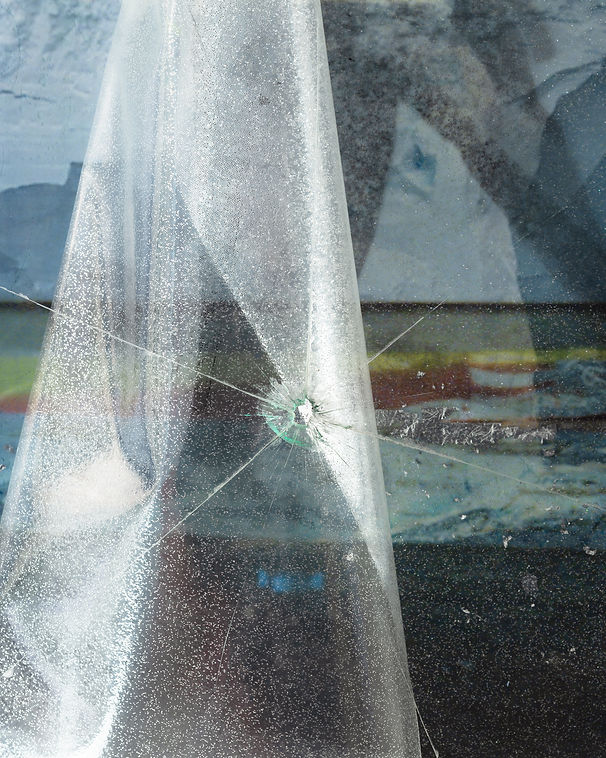
On the walls surrounding the ice blocks on the crash mat hang three glass vitrines with transparent silkscreen prints layered on top of one another. The surfaces of the glass are shattered, refracting the light from the façade’s large window sections. Because the glass is broken, the surface offers renewed insight into the many layers of images behind — of bodies falling, or icebergs drifting in the open sea. The silkscreen prints are layered so densely that it is difficult to distinguish them from one another, and the hole in the glass functions as a prism, adding yet more interpretative possibilities. I now see that the different representations of ice refer to multiple phenomena simultaneously, depending on their form. Just as Derrida’s deconstructivist authorship can also be read as an anti-capitalist critique of power, showing that his relativist thinking was in fact an ethical project concerned with making space for voices excluded from dominant systems. I sense the same insistence on counterculture in Julie when she speaks about her long-term investigations of the body, sliding and collapsing in an attempt to understand the relationship between human beings and their surrounding structures. As we continue speaking, I write: body = ice. That ice can exist in one environment but becomes water in another. And that a collapse can signal both an ending and a new beginning.
Text by Laura Goldschmidt.
[i] National Snow and Ice Data Center, “Iceberg A23a,” 2024.
[ii] Nasa Earth Observatory, ”The Long Life of Icebergs A23a,” 2020.
[iii] IPCC, Sixth Assessment Report, 2021
[iv] NASA, “The Carbon Cycle and Deforestation,” 2022
[v] FAO, “Soil Erosion and Rainfall Intensity,” 2019.
[vi] Inge Lehmann, “P’,” Publications du Bureau Central Séismologique International, 1936.
[vii] Dziewonski & Anderson, “Preliminary Reference Earth Model,” Physics of the Earth, 1981
[viii] Xiaodong Song & Yi Yang, “Changes in Earth’s Inner Core Rotation,” Nature Geoscience, 2023
[ix] Jacques Derrida, Glas (Paris: Galilée, 1974). Glas is a French word for the slow, solemn, and often ominous sound of a bell, typically rung to announce a death or the end of an event.
[x] Jean-Paul Sartre, Saint Genet: Actor and Martyr, trans. Bernard Frechtman (New York: George Braziller, 1963).